(As seen on The Today Show, Good Housekeeping, HerViewFromHome, ScaryMommy, The Huffington Post, Mamamia, MomsEveryday, and numerous social and news media outlets. UPDATED – 3/3/2017)
Friends, as most of you know, I get to spend an hour each week with a group of young people going through addiction recovery. Yes. Young people. I’m talking teenagers who are locked away for at least six months as they learn to overcome their addictions. I’m always humbled and honored to get this time with these beautiful young souls that have been so incredibly assaulted by a world they have yet to understand. This also comes with the bittersweet knowledge that these kids still have a fighting chance while several of my friends have already had to bury their own children.
Recently I asked these kids a simple question: “How many of you have found yourself in situations where things started happening that you weren’t comfortable with, but you stuck around, mainly because you felt like you didn’t have a way out?”
They all raised their hands.
Every single one of them.
In the spirit of transparency … I get it. Though in my mid-forties, I’m still in touch with that awkward boy who often felt trapped in the unpredictable currents of teenage experiences. I can’t count the times sex, drugs, and alcohol came rushing into my young world; I wasn’t ready for any of it, but I didn’t know how to escape and, at the same time, not castrate myself socially. I still recall my first time drinking beer at a friend’s house in junior high school—I hated it, but I felt cornered. As an adult, that now seems silly, but it was my reality at the time. “Peer pressure” was a frivolous term for an often silent, but very real thing; and I certainly couldn’t call my parents and ask them to rescue me. I wasn’t supposed to be there in the first place. As a teen, forcing down alcohol seemed a whole lot easier than offering myself up for punishment, endless nagging and interrogation, and the potential end of freedom as I knew it.
X-Plan
 For these reasons, we now have something called the “X-plan” in our family. This simple, but powerful tool is a lifeline that our kids are free to use at any time. Here’s how it works:
Let’s say that my youngest, Danny, gets dropped off at a party. If anything about the situation makes him uncomfortable, all he has to do is text the letter “X” to any of us (his mother, me, his older brother or sister). The one who receives the text has a very basic script to follow. Within a few minutes, they call Danny’s phone. When he answers, the conversation goes like this:
“Hello?”
“Danny, something’s come up and I have to come get you right now.”
“What happened?”
“I’ll tell you when I get there. Be ready to leave in five minutes. I’m on my way.”
At that point, Danny tells his friends that something’s happened at home, someone is coming to get him, and he has to leave.
In short, Danny knows he has a way out; at the same time, there’s no pressure on him to open himself to any social ridicule. He has the freedom to protect himself while continuing to grow and learn to navigate his world.
This is one of the most loving things we’ve ever given him, and it offers him a sense of security and confidence in a world that tends to beat our young people into submission.
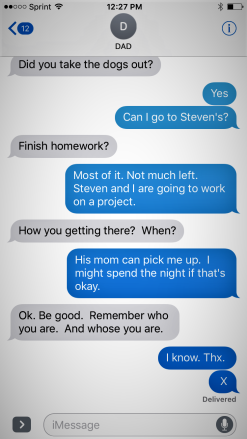 However, there’s one critical component to the X-plan: Once he’s been extracted from the trenches, Danny knows that he can tell us as much or as little as he wants … but it’s completely up to him. The X-plan comes with the agreement that we will pass no judgments and ask no questions (even if he is 10 miles away from where he’s supposed to be). This can be a hard thing for some parents (admit it, some of us are complete control-freaks); but I promise it might not only save them, but it will go a long way in building trust between you and your kid.
(One caveat here is that Danny knows if someone is in danger, he has a moral obligation to speak up for their protection, no matter what it may cost him personally. That’s part of the lesson we try to teach our kids—we are our brother’s keeper, and sometimes we have to stand for those too weak to stand for themselves. Beyond that, he doesn’t have to say a word to us. Ever.)
For many of us parents, we lament the intrusion of technology into our relationships. I hate seeing people sit down to dinner together and then proceed to stare into their phones. It drives me nuts when my kids text me from another room in our house. However, cell phones aren’t going away, so we need to find ways to use this technology to help our kids in any way we can.
Since first publishing this piece, I’ve seen an incredible amount of discussion about the pros and cons. Here are some of the questions folks have had:
Doesn’t this encourage dishonesty?
Absolutely not. It actually presents an opportunity for you as a parent to teach your kids that they can be honest (something DID come up, and they DO have to leave), while learning that it’s okay to be guarded in what they reveal to others. They don’t owe anyone an explanation the next day, and if asked can give the honest answer, “It’s private and I don’t want to talk about it.” Boom! Another chance for a social skill life-lesson from Mom and Dad.
Does this cripple a kid socially instead of teaching them to stand up to others?
I know plenty of adults who struggle to stand up to others. This simply gives your kid a safe way out as you continue to nurture that valuable skill.
What if this becomes habitual?
If you’re regularly rescuing your kid, hopefully your family is having some conversations about that.
If you don’t talk about it or ask questions, how do they learn?
If you’re building a relationship of trust with your kids, they’ll probably be the ones to start the conversation. More importantly, most of these conversations need to take place on the FRONT-side of events. Ever taken a cruise? They all make you go through the safety briefing in case the boat sinks. They don’t wait until the ship’s on fire to start telling you about the lifeboats. Talk with them. Let your kids ask questions and give them frank answers.
If they’re not where they’re supposed to be, shouldn’t there be consequences?
Let’s be honest. A kid in fear of punishment is a lot less likely to reach out for help when the world comes at them. Admitting that they’re in over their heads is a pretty big life-lesson all by itself. However, don’t get so caught up in all of the details. This isn’t a one-size-fits-all scheme. Every parent, every kid, and every situation is unique. What it might look like in your family could be totally different from mine—and that’s okay.
I urge you to use some form of our X-plan in your home. If you honor it, your kids will thank you for it. You never know when something so simple could be the difference between your kid laughing with you at the dinner table or spending six months in a recovery center … or (God forbid) something far worse.
At the end of the day, however, the most important thing is that you’re having some open, honest discussions with your kids. Keep building a relationship of trust. This isn’t the same world we grew up in. It’s not like sneaking a beer at Billy’s house anymore. Our kids face things on a daily basis that—given one bad decision—can be fatal. Don’t believe me? I’ve been to funerals for great kids from awesome families.
Friends, it’s a dangerous world. And our kids are out in it everyday.
Prayers for strength and compassion to the parents out there as we all try to figure out this whole parenting gig—it never gets easy.
I beg you to share this piece. Talk about it with your kids. If this somehow gives just one kid a way out of a bad situation, we can all feel privileged to have been a part of that.
#xplan
Blessings, friends.

Release date from Simon & Schuster / Howard Books: June 11, 2019.

 Bert Fulks
Thanks Bert.
We don’t have a set thing like this, but I have told my kids zillions of times that they can always “blame” me. You know, “oh, my mean mom says I need to come home, blah blah blah”
LikeLiked by 3 people
Thanks, Grace. No pun intended, but that’s gracious love!
LikeLike
We had the same thing in our family. My mom would say to just ‘blame’ her and we would be rescued. I did use it a few times.
LikeLike
Same. All the teens have their noses buried in their phones and all the phones are pass word protected. The x is not needed. My teen has been blaming me to get out of stuff like this for years.
LikeLike
Same deal in our house. I could just say that I wasn’t allowed to go, and call my mother names. Never had to really, my friends knew I didn’t like the taste of alcohol, etc. and never mocked or pressured me about it. As we got older, I was pretty handy to have around as a designated driver. They all showed up tipsy at our door (on foot) once; mom just let them in. She’d rather have everyone at home than wandering about. 30+ years and 10 kids between us, and we’re all still friends. ❤
LikeLike
We tell our kids the same thing…..just use us as an excuse to leave early, not go at all, whatever theyt need to say!
LikeLike
Yeah, I always say “make me the bad guy, that’s my job”. This doesn’t mean we won’t eventually discuss the what/where/who/why that made the child uncomfortable, but I’m happy to be the mean old mom who’s telling them they can’t go or can’t stay.
LikeLike
My parents did the same thing. I could blame them for anything to get me out of a rough situation. I never had to use it, but I was glad it was there.
LikeLike
I have always done the same, too! I tell my kids all the time that if they can’t think of a way out or if they feel uncomfortable or pressured by their friends they can “blame” me. They are allowed to say, “My mom says I have to be home.” “My mom says I can’t go out right now.” Anything they need to.
I’ve also learned to have a poker face so that my children can talk to me openly about stuff they’ve done. My oldest daughter was really wild since she was undiagnosed bipolar and had a run in with substances. She’s grown with children of her own but STILL uses the “Mom Excuse” even being out in another state. 😀 “I told my mom I would call her” and then she calls me no matter what time of day or night it is and I play along that I need to talk to her right now.
I feel that it is my job as a parent to be my child’s safest place. They can come to me with anything and I will not judge them. I will give them advise, but no judgement.
LikeLike
*tears* Thank you. I was a diagnosed bipolar teenager, and had no such outlet. Life was big, scary, and hard. Thank you for protecting your daughter, giving her a haven, even now she is grown. You are an amazing mother, and I am blessed to have read your story.
LikeLike
If a kid is not where they are suppose to be it is critical to correct the behavior. I get building trust- the overall goal of X plan but a line must be drawn.
By your own admission your kids could be in Idaho, throw an X through text and guess who is going to Idaho with no questions asked before, during, or after a very long drive.
A panic button is fine but we have to continue the dialogue and guide our children in the right direction especially during embarrassing troubling times.
Don’t be afraid to talk to your kids. After all they need structure and count on us to act like we care instead of driving home in silence.
LikeLiked by 1 person
Thanks for adding that, Patrick. Dialogue and guidance is huge. However, the comfort and trust I’m talking about forging is one that allows those conversations on the front side of events rather than on the back side; but even then, the kid knows they’re free to talk at any point without a full interrogation. I’ve seen this degree of trust work in our older two: they know they can come to us with absolutely anything and we’ll be honest and frank—they trust us and value our thoughts; likewise we trust they won’t be in Idaho. But even if they were, the deal stands. I’ll go to the ends of the earth to save my kid and pray that much-needed conversations are had at the right time.
I sincerely appreciate your thoughts on this. There’s no perfect prescription for parenting.
Best wishes.
LikeLiked by 2 people
What about a consequence for being where they shouldn’t have been?
LikeLike
If a teen is old enough to go out on their own, they are old enough to bear the responsibility of that. Why does there need to be a consequence for not being where they said? Imo, if you are to use this method then the parenting comes before the party. The lesson was learned when they realized it was unsafe, on their own, and called for help. We all must be afforded the ability to err of our own accord.
Now it might be different if the teen repeatedly made the same mistakes. At that that point it isn’t really a mistake but an easy out. I don’t think that is what the author is talking about here.
LikeLiked by 3 people
Karyn, I remember two specific instances when I was a teenager being where I WAS supposed to be, and having kids who were NOT supposed to bring alcohol. One was after a high school dance. Bless his soul, as soon as the beer showed up, my date looked at me and said, “Let’s go.” I will be forever grateful that he didn’t even give me a chance to think about it. We were out. Another was with friends I’d hung out with for all of high school. But I guess at the end of our Senior Year, some of them decided it was time to try drinking. I was at the house I told my parents I’d be at, with friends they had known for years. Anyway, just saying, you never know when things will go south.
LikeLiked by 2 people
Love this!
My kids are all under 10 atm and we homeschool but we already have a youngsters version of this. Even in the homeschool playgrounds there are morally questionable games and conversions going on as well with peer pressure to varying degrees. My kids all know that if ever they are in a situation that they aren’t comfortable to say “no” to they still have a way out. This will stay in my parenting tool box for later on in their lives.
Thanks!
LikeLike
I would way rather pick my kid up in Idaho with 0 conversation about it, then then being stuck in Idaho while people are asking them to do drugs with no way out.
LikeLiked by 1 person
I think the consequence is they have to be bailed out by their parents, they realize that maybe they are not as smart and sophisticated and independent as they thought, and they learn that their parents always have their back. I would hate for my daughter to have to weigh between “stay someplace I don’t feel safe or where I’m not comfortable and maybe things will turn out okay” and “call Dad and deal with a consequence.” I want her to always know “call Dad and things will turn out okay.”
LikeLiked by 1 person
In my mind, the consequence for being where he shouldn’t be is that he had to call me for help. The self awareness to get yourself out of a bad situation is a skill I want my child to have, and I think coming to the realization that he’s in over his head teaches a much stronger lesson than any grounding or loss of privilege that I could impose.
Moreover, the safety of my child is my primary concern if they’re in an unsafe situation. The idea of consequences or punishment are secondary. And having been the teen in this equation, this safety net does not work if a child is afraid to call their parents.
My parents taught me that no matter what, I could always call for a ride if I had been drinking or my ride had been drinking. I wasn’t allowed to drink as a teen, and wasn’t supposed to be at parties where drinking was happening. I only had to call them once, and there were no consequences. If I had been afraid of punishment, I may have made a different, potentially fatal, choice. That said, my relationship with my parents was strong enough that just having to call them, and face my dad when he picked me up and I’d clearly been drinking, kept me from ever getting myself into that situation again. So even if there aren’t any parent-imposed consequences, I would hesitate to say that implementing a plan like this is truly consequence-free.
LikeLiked by 1 person
This works today for my 18 and 20 yr old! They know they can call at anytime and I will come get them! They know between right and wrong; however, young adults get in bad situations and they need an out! We have used this since they were young teens. I am glad to say, I have only had to go get 1 of my kids!! My 21 year old is now a Combat Medic and all three are doing great!
LikeLike
I think you are missing the point. The no lecturing and no consequences thing is key to this working. You want them to have an out that they are willing take WITHOUT HESITATION. When they’ve sent you that text, they’ve made the right choice. They’ve chosen to get away from a bad situation. They’ve hopefully also learned a lesson about what situations to avoid in the first place. Mission accomplished, they’ve learned their lesson in a much more natural and impactful way than any parental lecture or punishment can accomplish.
LikeLiked by 8 people
Yes!!! Exactly.
LikeLike
I really disagree on this being 100% consequence free (although you’re right…no perfect prescription for parenting). However, dialog and consequences don’t have to equate to a huge fight. X-Plan can still work. Kids are not afraid of consequences. They are afraid of conflict…hence the very nature and need for Plan X!
Setting limits and enforcing those limits teaches children forethought, responsibility, and respect for rules and for your judgement of what is ok and what is not, as their parent.
If they have to X-Plan you at party you agreed to let them attend, but it got out of hand – that’s one thing. Nothing but praise for a responsibile assessment of the situation should be doled out. However, if they have to plan X you because they told you they were going out with a group of friends, when in fact they were out with a boy whom they know you disapprove of (maybe, for example, because they are 15 and he is 19) and things got out of hand…that is quite another.
You have to enforce the rules you set, and consistency is key. Here is where our opinions differ:
Enforcing the rule does not mean a knock down drag out. They already know they were in a situation they were not equipped to handle, so you both know your judgement was the correct judgement in the situation. Now is the perfect time to discuss it! “This is why I didn’t want you in this situation.”
“How did you feel about what happened?”
“Do you think someone who respects and cares for you would have made you feel that way?”
“Do you think you could have made better choices?”
“Do you now understand that our not wanting you in this situation is because we care for you and your well being, both mentally and physically?”
“Do you understand your worth as a human, and that no one has the right to make you do anything you don’t want to?”
“Now that you’ve had this experience, and you know how you feel, how do you think you’ll handle it in the future?”
“You’re going to be an adult soon, and even then you may misread someone and find yourself in a situation you don’t know if you can handle. You can still X-Plan us, or a trusted friend if they are closer. The most important thing is that you are safe.”
At that point you are in a perfect position to calmly talk about what went wrong, and how disregarding the rules added to an already unsafe situation. Then you can talk about consequences and how being on restriction for a weekend is a far better punishment than if they hadn’t had a safe and reliable out for the situation they were in. You also can and should praise them for contacting you – even when they knew they had broken the rules! If you keep it calm, caring, and to the point (i.e. Not bringing up old situations or transgressions) I don’t see why they would be reluctant to use Plan X in the future.
LikeLiked by 1 person
Emily, speaking as someone who was a rebellious teen, it is my firm belief that the X plan *will not work* without the consequence-free caveat. If your kid goes somewhere they’re not supposed to be, trouble is more likely and more likely to be serious, but they won’t panic button out if they’re fearful (and consequences *can* be scary, not just conflict; this is no less true for kids than for adults). This is not to say that if they violate the contract by running off to Idaho, this can’t or shouldn’t inform your parenting going forward–damaging trust damages relationships, and this consequence is both serious and inescapable. But the drive back from Idaho is probably not the right time to connect those dots, and the formulation of a X plan or similar panic button scheme is probably not the right time to make a threat of that or any other consequence.
Structure is incredibly important, as you say, and no parent is a machine, nor should we be; interpersonal dialogue is a part of *every* parenting decision. And some kids may not be ready for the kind of trust this plan is built on (some kids may not be ready to go anywhere without direct supervision by a trusted adult). But in general, I can’t teach my children more tomorrow if I can’t help them to be safe today, and I can’t do that if the line I throw them in the most dire circumstances comes only with conditions.
LikeLiked by 2 people
I agree. And they will learn from the fact that they needed to be rescued that their disobedience was a bad idea!
LikeLike
Emily, if, as you say, “The most important thing is that you are safe,” then that is the most important thing. Love, acceptance, and forgiveness are infinitely more powerful than punishment and restriction.
LikeLiked by 1 person
I think the fact that they are using plan X is enough of a punishment. They are admitting to you that something is wrong. They could have stayed and engaged in the behavior, but by sending that X, it shows that they recognise the situation is wrong and that they have to have the guts to admit it to you, rather than keep it a secret. You don’t have to know all the details. I think sending the X, and knowing what it implies is enough.
LikeLike
I think as a parent, giving up control is often harder than holding on to it, so I respectfully disagree with the characterization of the “no questions asked” policy as one of laziness or apathy. I had a similar agreement with my parents growing up, and I think it helped me to trust and follow my instincts, and I really respected the fact that they valued my safety over their parental urge to question and lecture. I can only speak for myself, but it’s not something that I abused or took for granted, and it allowed me a couple of times to remove myself from situations that I was not comfortable in (which I likely wouldn’t have done if I’d known that I was going to get the third degree for calling them).
LikeLike
I agree completely. My mom trusted me and gave me a lot of leeway, with the understanding that she was always there, without judgment, if I needed her. And guess what? I felt zero need to rebel, to fight for that independence teens crave. I got myself out of bad situations because I had a strong sense of self. My mom wasn’t there or making rules for me to follow, but her trust was a precious gift that I valued. So I was a “good” kid (all kids are good – you know what I mean). No alcohol, no drugs, no sex – even when it was all around me, even when my best friends and boyfriend were doing it. I will absolutely be the same safe space and source of strength for my two children.
LikeLike
If you attach consequences to this – it will work exactly one time. If they ever find themselves in a bad situation again, they will not be calling you. Dealing with their parents becomes a pain in the ass then, and it’s easier to give in to friends.
LikeLiked by 1 person
Exactly.
LikeLike
Well as a Mom of two daughters just getting to their tween years, I see your point. I’m also a control freak so I don’t even know how I’d do with the whole “no questions asked” part of this plan…but I think in a situation like you offered the “no questions asked” would fly out the window. It’s an extreme circumstance after all.
LikeLike
If you’re afraid that your need to have control will override the rest, one option might be to find someone you trust to be this person for your children. When I was a kid, my mom’s best friend was my “person.” She would ask no questions and say nothing to my parents (although I imagine there must have been provisions if my life was in danger or something like that). Fortunately, I never needed to call her, but the option was there if I ever found myself in a situation I couldn’t handle. The hope is that your relationship with your children is strong enough that they’ll tell you about what happened on their own, but knowing they don’t HAVE to will make it easier for them to make the call.
LikeLiked by 1 person
Lisa, its not too late to establish that absolute trust between you and your daughters… if they know and BELIEVE that you only want what is the best for them, and make sure they understand they can talk to you about absolutely anything.
I was raised in a very strict religious/cultural environment so we never even had sex ed at home, much less show or be showed affection to! I promised myself that my children would always know how much I love them and that I would do anything for them. I also had to make an effort not to judge them!!!
This is what my daughter told me (now that she is older), she appreciated the most was me not judging her when she confided in me … believe me I had to bite my tongue on many occasions! And it has really paid off .. she is confident, kind and loving and is happy!
LikeLike
And your response here is exactly why my mom has no idea who I really am. I figured things out for myself to spare myself her judgement and “guidance”. I joined the military and then told her instead of the other way around because I didn’t want to hear her thoughts. I didn’t trust her to trust me, so I left her out of the loop. I am 35 years old and still don’t have a trusting relationship fully… because I figured out how to navigate the world on my own without letting her in. Habits from my adolescence created who I am today. Please reconsider having a no questions ask policy. If your child implements the X plan, they don’t need further guidance. They just made the right choice! Give them compassion and forgiveness, so that they don’t get in the habit of figuring out how to navigate the world without you. At least… this is how I reflected upon my upbringing.
LikeLiked by 1 person
I don’t think there are no ramifications even if they aren’t doled out by the parents. I ended up in Florida 800 miles away from my parents. I wasn’t a “minor”. I was 18, but I still needed rescued. I definitely understood the seriousness of not being where I was supposed to be. My parents never lectured me because they didn’t need to. It never happened again.
LikeLiked by 1 person
If they think they will be confronted, they might not decide to follow the plan and give you the chance to help. Trust your kids. If they let you rescue them, they know they should not be where they were. They will talk when ready.
If it becomes a pattern, it needs to be addressed. If it happens once or a few times, you will have to live with the suspense and know that your kid can ask for help when needed, for the sake of the plan continuing to be available and effective.
LikeLike
Speaking only for myself, I would like to say that had this sort of plan been in effect during my rebellious stage, my life would have turned out much differently.
This plan would have said to me, “I trust you and you can trust me.” Not having the security of knowing my parents trusted me, I didn’t trust them back. I lied about going to places I wasn’t supposed to go, and when I did get in trouble, I ran away from home at 17 instead of asking them for help.
I don’t blame them at all, and have a great relationship with them. But it took three years and one baby to learn that I could have trusted them with anything from day one. Had I had that security, and a plan, I would not have felt the need to lie in the first place and avoided a lot of trouble.
LikeLike
If your child has sent the “X” text, then that means that they themselves have realized they have made a mistake, and does NOT need a consequence beyond that.
Have you ever made a decision and then realized that it was a mistake? Then, you got yourself out of that decision? The act of sending the X is, in itself, an admission of having made a mistake. It is also an acknowledgement that it’s time to get out. What consequence do you really want to give on top of your child having learned to take responsibility for their mistakes, and also to actually realize and admit when having made one?
LikeLiked by 1 person
lol Patrick, you don’t have kids do you?
LikeLike
Patrick’s gonna have sneaky teens.
LikeLike
I like this, but what do they say when they get back to school and people start asking them what happened that they had to leave so quickly?
LikeLike
I thought the same exact thing!!!
LikeLike
I can think of a few little white lies that would be easy enough… “the dog got out and they needed help looking for it”, “I had the only house key and my parents were locked out”, “an old friend came by that I hadn’t seen in years”.
LikeLike
Hell, I’d even let them blame me. “My mom got home and saw that I didn’t do [chore] and flipped out on me.”
LikeLike
The child really doesn’t have to say anything to his friends. It’s none of their business but if they feel they need to reply they can just say it was a personal family problem. No lying there….
LikeLiked by 1 person
Best answer yet!! And they don’t have to lie because we all know that first lie comes with the second then it’s off to the Lying game….
LikeLike
I think they can have some responses that do not include lying… “We had a private family matter” or “I really can’t talk about it.” I never think it’s a good idea to teach your kids that lying is ok.
LikeLike
Then that’s a personal issue for the family to sort out themselves. I personally have zero problem with my children telling a small lie if it gets them out of a situation where they feel uncomfortable or unsafe.
LikeLiked by 1 person
Could even precede by “It ended up not being that big a deal,” so the “I’m not really at liberty to talk about it” doesn’t sound as juicy
LikeLiked by 1 person
In this case a little white lie such as ” the dog got sick” will suffice.
LikeLiked by 2 people
They can say it turned out to be nothing.
LikeLiked by 1 person
Just for clarity in your example screenshot mom contacted her son a few minutes after giving the OK and rescinded the overnighter due to the final ‘x’ ?
LikeLike
The child’s words are in blue. We are to assume that he’s at the sleepover, and after a while he texts his parents the X when something’s going down that he needs to get away from.
LikeLike
I. LOVE. THIS. We’ve always told our kids that if they’d rather not do something, to whisper to us, or indicate so when the friend isn’t looking, etc and we can be the bad guy for them. They have all used it at one time or another, but this… THIS is great and extends our offer to when they are gone and they don’t have to call on the sly, just a quick text. Perfect! Thank you for sharing this!!
LikeLike
This brought tears….thank you. We buried our precious son (my son by another mother) in November 2015 and while he wasn’t a teenager the problems started then. I hope EVERY parent who reads this will put it or something similar in place for their child. I would wish no parent ever would have to go through what we did.
LikeLike
Reba, i am sorry for your pain in dealing with the ordeal. We have had 2 tradgedies in our area lately. It has created so much judgement of the people involved who were obviously hurting to make the poor choices they made, but it made me wonder why we are so quiet about the filth in our societies. Why aren’t we saving these lost souls by speaking out Against
the filth, like “50 Shades of grey”, “Game of thrones”, and the many mature video games out there for teens whose parents are obviously working their fingers to the bone working 2 jobs. Why can’t we see that our society is broken and vocally stand up and fix it?
LikeLike
I am so sorry for your loss. Thank you for sharing your heart.
LikeLike
Thank you for this. When my oldest daughter was a teenager (pre-cellphone) she was told that she could use whatever words she needed to get herself out of a dangerous or uncomfortable situation. She has since told me that this policy helped her a few times. My 4 younger daughters are now in high school and college. They have at least 5 people they can reach out to for a rescue.
I will be sharing this x-factor plan with them because we have had a few instances where they sent a text asking to go somewhere that they didn’t want to go, but, the person inviting them was reading their texts. This is the perfect solution. Thank you again.
LikeLike
I’ve read that an agreement for the kid to call or text in code. If the child WANTS to go, they text something like “can I please go to such and such” and if they DONT want to go they can text or say something like “would it be ok if I go to…” they’ve still asked, just in a way the parent understands whether or not they really want to go.
LikeLike
Reblogged this on I Have a Forever and commented:
My parents always assured me that I could call them to come get me no matter what and I could always use them as a way out of something that made me uncomfortable. I appreciate that and I love this idea for the world that my girl is going to grow up in.
LikeLike
Hey Bert, thanks for this excellent article! I am the editor of ForEveryMom.com and I would LOVE to re-publish it there. Can you shoot me an email to discuss? jrapson at outreach dot com. Thanks so much!
LikeLike
Reblogged this on Replenish and commented:
Parents have a lot more to deal with in the current culture than our parents before us. Technology via mobile phones have invaded our lives. And it can be downright scary with games that allow total strangers to chat our primary school-aged kids up! With all the games that are out there, it’s hard to keep up with what each does and allows. Really… it’s quite impossible. Parents ultimately need to have a good relationship and be watching what their kids are playing and how they are interacting and of course… have open communication about the do’s and don’ts. For #FamilyFriday we are sharing this link about a tip to help parents of teenagers….
LikeLike
Pingback: Give Your Kids A Way Out | ReplenishFest
Reblogged this on Condemned 2 Redeemed and commented:
LOVE this idea. I always tell my teenage girls to blame me if they need an out/excuse, but this is a great addition! Thank you for sharing!
LikeLike
LOVE this idea. I always tell my teenage girls to blame me if they need an out/excuse, but this is a great addition! Thank you for sharing!
LikeLike
Thank you. Heading into teenage years in the next few years, this is a strategy my family will definitely adopt. Already my children know to add a “pleeeeeeease” to any request in front of friends if they really don’t want to do what they are asking , in order to save hurting feelings. When they ask me this way, I know by our code that they need me to say no. It works a treat!
LikeLiked by 1 person
Pingback: X-Plan: Giving your kids a way out (#xplan) – dawns-ad-lib.com®
Thanks Bert. Timely post as my 14 year old literally just walked in and asked to attend a party tonight. I had him read your post and bam…we now have an X plan. Love it!
#rhinomomblog
LikeLiked by 1 person
Reblogged this on howsyourlovelife and commented:
We have done something similar for years, but without spelling it out quite like this. Please parents, be this for your teens.
LikeLike
Reblogged this on And 2 Makes Crazy and commented:
hi friends…i don’t quite have a teenager-teenager yet—but we are REALLY starting to have real conversations … and these situations are just around the bend. THIS is a really good article to read. perhaps some of it will resonate with you an ah-ha moment or give you ideas for your own brood. xoxo b
LikeLike
We have something similar for our daughters. All the need do is text us about ginger pancakes and we will come and get them. I tell my girls all the time that I am willing to be the bad guy, so they don’t have to.
LikeLike
I love this. I predate cell phones, but my parents always told me that no matter what they would come get me, no questions asked. We also had a “code” starting in middle school, where if I wanted to do something I would ask using “may”, and if I felt pressured or didn’t want to, I would ask using”can”. Can, ends in N meant I wanted them to say no. May, ending in Y meant I wanted them to say yes, though it was still up to them. I still appreciate them doing that for me.
LikeLiked by 1 person
What an excellent plan!
LikeLike
I understand how difficult peer pressure is, but why are we supposed to be more concerned with kids being made fun of by someone doing drugs, drinking, etc. than teaching them to stand up for what’s right? Where is the personal responsibility being taught? They can’t always call someone to help them because they’re in a difficult situation. Where are the lessons for facing those things head on? Avoiding ridicule by hiding the truth is not navigating the world. I used to think this was a great idea, and maybe for younger teens it may seem like the only way out. But there has to be more and they must learn to say what they think, feel and know.
LikeLike
I think that these are two complimentary skills, not two opposing ones. It’s very healthy to know when to get out of a situation and when to walk away, and it’s valuable to help young people to develop the agency to do that. It’s certainly *also* healthy to stand up for yourself and others, and this also requires agency, and is much easier to do when it’s a *choice* and not the only available alternative to capitulation. While life doesn’t always offer us a ready exit, practice and developing confidence and agency are valuable stepping stones, particularly at an age where social consequence is a lot more meaningful than just being made fun of.
LikeLike
Sometimes “No” isn’t enough. A kid’s peers have a much greater influence on them than parents do, particularly when they are surrounded by them and parents aren’t around. If a teen has good friends, a
“No” will suffice, but not all kids are good. Pressure and bullying can overwhelm someone and wear them down to the point where saying “yes” is easier than continuing to resist. I wasn’t a very strong kid, so I got worn down pretty quickly.
LikeLike
LOVE this! Thank you. Any suggestions for kids who don’t yet have a phone?
LikeLike
My kids grew up before cell phones were a “thing”. They, and their friends, knew they could call any time, or call collect, and I would come get them. No questions ask. Some are still amazed that we still have the same number, for over 30 years, and they still get Mom.
LikeLike
My son text us “Migraine”. He does have severe, chronic migraines, so none of his friends would think that was weird. We’ve also practiced saying “if I drink on my migraine meds Ill wish I was dead”.
LikeLike
This is such valuable information, thank you!
LikeLike
Pingback: X-Plan: Giving your kids a way out (#xplan)
I support this idea 100%, we have done something close with our kids, but this explains it so well and quantified the importance and impact. I re-blogged this on mine, something I have only done twice in more than five years!
LikeLike
As a reply to no one specific, but to those saying that “kids should learn consequences of bad behavior”:
What about the fact that your kid _could_ have chosen to go along when things went south, but didn’t? Doesn’t that merit some sort of recognition? I know that if my daughter were in a bad situation and told me she wanted to come home, I’d give her big hugs for being bold enough to stand up and say no. If I launch into a tirade about “Why were you there? What were you thinking? _____ could have happened! You’re grounded. Go to your room!” She would never open up and trust me again.
I’d much rather take the learning opportunity approach and have her trust that I trust her judgement. It builds their self-esteem and shows that you trust them. Otherwise next time they _will_ stick around and see if what could have happened is any worse that what mom and/or dad did.
LikeLiked by 1 person
We did something similar with our kids so when they were asking to do something in front of their friends we knew when to say no. If in person, they would scratch their nose and if in text, they would start the text with mom. By putting a period after mom, I knew that I should reply with no. Worked great and their friend were none the wiser. I like the xplan as well because its hard to get away once you’re in a situation. Thanks!!
LikeLike
We’ve told our kids they can call and ask if we remembered to feed the dog. That is our queue that we can call them back (or the person they are with) and tell them we had a family emergency and we need to pick up our child. So far we haven’t had to use it. But I love this idea of texting ‘X’. Quick and easy and perfect for our texting world.
LikeLike
Reblogged this on Not Quite Home and commented:
A good plan… Pass it on.
LikeLike
X-plan is a great fallback but it’s a bit of a one-shot deal. How many times is it possible to claim that, at the point of temptation, “something’s happened at home”? From memory, adolescence offered up many opportunities where an x-plan could be deployed. Having those conversations and providing support that builds resilience, confidence and self-awareness are critical because they need to fill the vacuum when the x-plan becomes redundant.
LikeLike
I had the same thing for my son. I also had the same thing when I was young. I used it a few times. I explained the situations I used it in to my son so he would now it was not just talk. He used it himself later on. We didn’t use the X but he knew he always had a pass and way out if he needed it and no explanation needed with no questions asked. He was always a great kid.
LikeLike
I could have used this when I was younger, I didn’t often like spending the night at my friends and my mom always said yes.
Just a question though, why x? Why can’t they just text that they need their parents to come get them? Like the special shot women can order to tell the bartender they want away from their date and need a cab. These special code words make it seem like asking for help is some dirty little secret. If the kid is worried about their friends somehow seeing the text they can always delete it right away.
LikeLike
X is a single letter that can be texted quickly, is my thought.
LikeLiked by 1 person
Reblogged this on @KellyOSullivan and commented:
What a superb idea.
LikeLike
Short & simple response here! I’m the mom to teenage sons, one who is 18 & graduating in a few months, let me add this:
If you choose to implement this plan:
YOU are the parent and YOU know your child better than anyone telling you what will and won’t work with this plan.
If there’s anything I learned (as I was the definition of a rebellious teen) AND now as a mom who has raised some awesome boys – is that there is NO ‘One way to parent’. Each child is blessedly different, as is each family dynamic – so if up choose to use this X-plan, than go with YOUR gut as to whether you have a consequence or not! Because I believe with my now 18 year old, I would use the consequences but with my 14 year old I wouldn’t, because they are their own person and each have very separate temperaments as well as attitudes.
LikeLiked by 1 person
One additional thing I did as a parent was to have an envelope with emergency money for cab fare in case we weren’t available to pick up our teen. The teen could call a cab and have money to pay when they arrived home. They knew not to touch this money in case one of them needed it.
LikeLiked by 1 person
I’m late to the party, but love this. Had similar with my older kids and am incorporating one in with my new teens. I just want to say, if it hasn’t been already. The bottom line is giving them a safe out when they realize they made a mistake and are in too deep. My personal goal as a parent isn’t to control or even dole out consequences, it is to teach them to make good choices and be able to navigate life on their own in a few short years when I won’t have control or even as much guidance as I do now. Because of this, and the fact that I’ve seen it work in 6 older children, who are now well into their adult life, I think this plan without parent dispersed consequences is a great parenting/safety tool.
LikeLike
This would be a great idea for a phone app. It would be like a phone tracker linked between the parents’ phones and the kid’s phone, but it’s only activated if the child opens the app and puts in a short password. That way if the kid is in actual danger then the parents’ phone atoumatically tracks their phone and they don’t have to make any noise. (I. e. someone is stalking or threatening them and they don’t want to alert the other person) Which I understand parents can track their kid’s phones, but not if they don’t know there’s trouble or if the child doesn’t have service to txt them.
LikeLike
Pingback: Hello Weekend! – CityMomCo
We had this. I would call my mom/dad and tell them i was cold, they would come get me no questions asked (before cell phones).
Also , if I didn’t want to go somewhere I would ask mom , she would ask me if i wanted to go, of i said not really, she then told me I wasn’t allowed to go. That way, I could blame her for not wantin to go to the party.
LikeLike
My kids are now 23 and 21 and I am very fortunate that they talk to me about EVERYTHING! At this point, sometimes it TMI (too much information) for me but I am glad they still talk to me and ask me for advice.
But this all started when they started kindergarten. Every night, I gave them each 10 to 15 minutes of undivided attention before they went to sleep. No matter if chores were done or not, they knew they always had that time with me EVERYDAY. They told me about their day … with my son, it was harder because he always “forgot” and everything was “fine.” But when I told him he had to make sure to remember 5 things throughout the day (remind his brain to remember), things were so much easier.
As they got older (teens), the time could be spent to “vent” and this meant no repercussions as long as they started the conversation with “Mom, I have to vent.” I didn’t judge, and let them talk and if they wanted my advice, I’d give it … more often than not, they did! I also found out more about their friends, how they related to other people and was able to guide them as things came up … they have also asked for my help for their friends and a few of them call me if they just need someone to talk to… which i absolutely love! My son recently made a comment about how he couldn’t understand how a mother could not always do what’s best for her children … his girlfriend has a narcissistic mother and treats her and her siblings horribly.
My daughter was bullied from K-5 grade so it was especially tough. The bullies did not get good grades and were just generally mean so in 2nd grade, I told her she had a choice … to dumb herself down to fit in, and if she did that, how low was she willing to go to fit in with these mean girls…she rightfully decided that she will just hang out with the boys because they were nicer anyway.
As she got into middle school, she was extremely eager to have a “best friend”, which was a very tough road for her to go through since she never had one when she was younger. She was drawn to the needier girls, which was fine, but she also learned the hard way about confiding everything to this “best friend.” I told her that if it was a secret that could later humiliate her, better tell only me, rather than other people because once that friendship is over, its guaranteed her secrets will come out.
She’s 23 now, done with college, lives in another state, has a good job and has a lot of close friends. She also has one wonderful best friend who they each confide to about EVERYTHING! She still calls me every few days to tell me about what’s going on with her life. She is kind and compassionate and my son is focused, sweet and funny…and I am so proud of them!
They used to think I was too strict when they were growing up but now appreciate it. They tried using the argument all through growing up “But so-and-so is allowed to do this etc” and my reply always was “so-and-so is not my child so it doesn’t matter what he/she is allowed to do or have …. “
LikeLiked by 1 person
Bert,
I coach parents who are struggling to manage the chaos of a child’s addiction. One of the biggest challenges is getting them out of their own way as they bring emotional baggage and judgement into the issue. The way out is a beautiful and simple answer to many related problems. You have my email address via this comment. Can you please reach out. I would love to talk more.
LikeLike
Sounds like a good plan. It’s too bad, however, that you make your son lie in order to get out of the situation. Then later, when his friends ask him what happened, he has to lie again to cover up his lie. You need to somehow utilize the plan without incorporating a lie.
LikeLike
I like the idea of this, but it’s also teaching your kids that it’s okay to lie instead of teaching them how to be their own advocate. Later down the road, they are going to be the kind of person who makes excuses to get out of or avoid situations instead of learning how to stand up for themselves or what they believe in. Which is worse; making a liar who is reliant on others to “save” them, or allowing your child to experience some minute social backlash because he or she stood up for what was best for them?
LikeLike
I absolutely agree with this plan and did this myself. We did the talking before any event and they were regularly reminded that they could ring me anytime and I would happily be the bad guy if it meant they got out of a situation where they felt unsafe, at risk, compromised (standards or beliefs) or uncomfortable.
We didn’t use an X txt but they would call or txt me in a way that their friends had no idea but that I knew was out of character for them. eg. “Mum can I go to this thing tonight because I really want to go!” when I had already said yes, or arguing back with me when I had said ok. I would straight away pick up on that, I’d say Do you want out? and they’d say yes or continue arguing with me. I would then immediately give them a reason why I had to come and get them now, and I would get into my car and go. They were always happy to see me. It was empowering for them because they knew I had their back at any time but they still had the power to decide when to call for back-up.
When your kid/teen/young adult has called/txted you for a way out, usually the reason will blurt out as soon as they get in the car anyway because they are just glad to be out! You may not get the full story but you’ll get enough to give you some idea of what was going on. Every time with my kids. And either way, I’d rather them be out and me not know why than have them stay in the situation because they didn’t want the third degree later on!
LikeLike
Bert — what a fabulously devised safety plan! Although I am not a parent, I have many nieces and nephews who are now parents, and will share this article with them.
I was not one to get involved with the “drug, alcohol, sex scene” as a teenager, despite “peer pressure” of the 1970s. However, I did try alcohol and pot (which made me quite sick), so would never consider myself angelic by any means! Yet, I was the only one from my “pack” that went to college and actually graduated!!!
I also work with youth … I am a RN in a community health clinic. I frequently have the “real” sex talk with these kids who have fabulous dreams, but are currently being re-evaluated because of STDs and/or pregnancy. I’ve also worked as an HIV/AIDS Case Manager, so this is also incorporated into our discussion … NOT lecture (that’s for their parent(s) to do!). Since many kids today have a more advanced mobile phone than I (and I am a professional working full time!), I will definitely incorporate this option into my conversation … both with the youth and parents!
Thank you for your work and presentation of this process within your family and youth group!
God’s Blessings✝️
LikeLike
Very cool.
LikeLike
My eldest son didn’t use a system like this, however, we had a rule that I didn’t care if he changed plans and stayed somewhere other than where we had arranged, as long as he let me know where he actually was so that I could find him in an emergency. If he wanted to have a drink at a party, he would ring me first and ask if it was ok to have a drink, and he always made sure that he stuck with the girls in his group and made sure they were safe. He also knew that if his friends rang him in distress, I would go get them and they could use our house as a safe haven from whatever was going on, as long as they let their parents know that they were safe and with us. He has had the same group of friends since he was 12, and they’re all still mates.
But I think that I will implement something like this with my four younger boys. A safety net is always a good idea.
LikeLike
I never thought of doing something like this, but I have done something else for my oldest daughter who’s almost 18 that has worked quite well, and will do for my youngest daughter when she needs me to. I told her that if she ever ended up giving in to or pressure, making a mistake of any kind, or having something bad happen to her, that she could come to me about it and not have to worry about me flipping out on her, but rather we would talk about it and with through it together. I feared telling my parents anything because I knew they (my dad especially, mostly because of it not being a good situation when I was growing up) would definitely flip out rather than help me. I vowed never to do this to my kids. We’re all teens once, and we all go existence couriosities, temptations, etc. What teens need is guidance, patience, and understanding, not judgement. Now, my daughter talks to me about anything and everything. I know the things she’s experimented with, mistakes she’s made, and something bad that somebody did to her. I’ve helped her through all of it, to learn from it, and she trusts me. She’s struggled with major depression, and I had to admit her New Year’s Eve this year. She came to me that day about how bad she was doing, and we talked about it, and agreed that she need to go. Now that she’s home, she’s doing much better and is thankful that I did it. She is a senior in high school this year and makes mostly A’s and B’s. She’s worked almost full time for the past year and bought her first car herself. She pays her own bills, and has plans to go to school for cosmetology after graduation, and is making plans and preparing for moving out on her own. She knows that even then I will always be here for her if she needs me. I know that I can trust her to make responsible choices, and I’ve allowed her a lot of freedom because of that. And she never disappoints me. I have even told her that when she’s out and something happens, or might happen, she can call me and I will do whatever I’m doing and come rescue her. And she has, and I’ve always gone to get her. And I’ve never flipped out on her for anything. I think I will add this idea of yours to my parenting. Thank you! And thank you for being there for the all of the kids who need someone!
LikeLike